

August 25, 2025
The Science of Sequencing
In rehabilitation and performance, the order of interventions matters.
Emerging evidence suggests that beginning with a neuromodulatory technique—such as NeuroKinetic Therapy (NKT) or Proprioceptive–Deep Tendon Reflex (P-DTR)—can create a short-term “window of opportunity” for improved movement quality and motor learning.
By influencing how the nervous system interprets sensory signals, these methods may:
- Reduce pain and protective guarding within minutes
- “Unlock” inhibited or maladaptive movement patterns
- Improve proprioceptive accuracy and muscle recruitment
- Prepare the body for more effective corrective exercise and loading
What the Research Says About NKT
Two recent clinical trials highlight the potential role of NKT as part of a modern rehab program:
- Plantar Fasciitis (Alayat et al., 2022):
Women treated with NKT for two weeks experienced greater improvements in pain, function, and plantar fascia thickness compared to those who performed foot-core exercises alone. - Chronic Non-Specific Low Back Pain (Shamsi et al., 2023):
Participants who received NKT over eight weeks showed significantly better results in core endurance, pelvic alignment, and quadratus lumborum flexibility than those following a core-stabilization program.
These findings suggest that NKT can outperform traditional exercise alone, at least in the short term, by preparing the neuromuscular system for more efficient movement.
Where Does P-DTR Fit?
While P-DTR is supported by compelling clinical anecdotes and neurophysiological plausibility, peer-reviewed randomized trials are still lacking. However, its theoretical basis—that targeted receptor stimulation can recalibrate maladaptive proprioceptive inputs—aligns with established evidence from neuroscience:
- Cutaneous and tendon stimulation can alter motor neuron excitability
- Manual therapy can modulate pain through segmental and supraspinal pathways
- Proprioceptive training induces cortical reorganization and enhances motor control
Thus, even though the branded method needs stronger trials, the principles are consistent with modern understanding of sensorimotor integration.
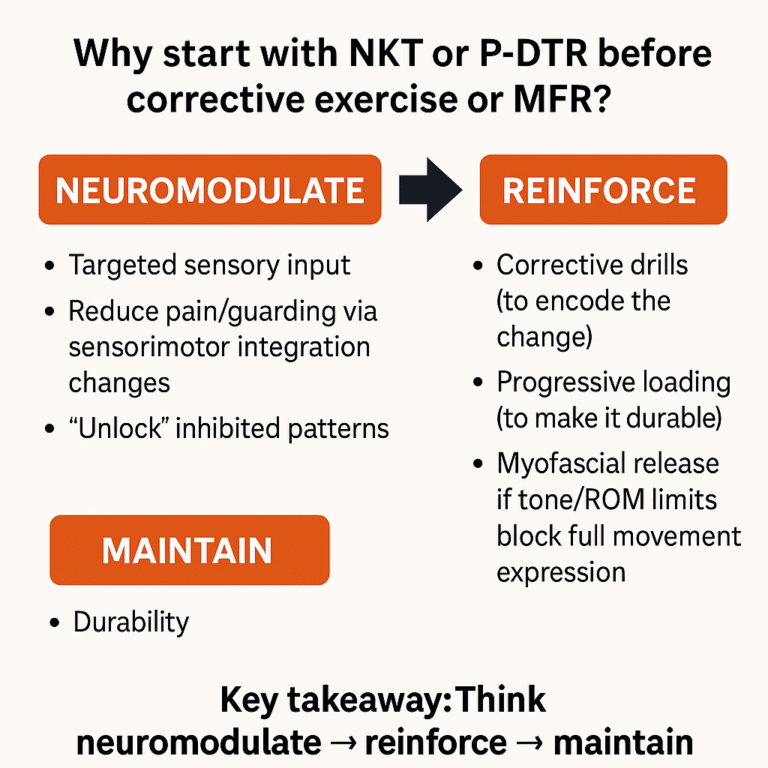
Why Not Start With Corrective Exercise or MFR?
Corrective drills and myofascial release are essential tools, but their impact is maximized after neuromodulation:
- Corrective exercise encodes new motor patterns and consolidates changes, but requires the nervous system to be “ready” to activate inhibited muscles.
- Myofascial release (MFR) can improve comfort and range of motion, but does not directly address maladaptive sensory processing.
By first reducing pain and releasing inhibitory patterns through NKT/P-DTR, the body is primed to accept and retain corrective strategies.
Practical Framework: Neuromodulate → Reinforce → Maintain
- Neuromodulate
Targeted receptor input via NKT/P-DTR
→ reduces pain, restores availability of inhibited patterns - Reinforce
Immediate corrective drills and progressive loading
→ encodes and strengthens new patterns - Maintain
Lifestyle, exercise programming, and education
→ ensures durability of adaptations
Conclusion
The growing body of research supports the idea that sequencing matters.
Starting with neuromodulatory techniques such as NKT (and potentially P-DTR) can create rapid improvements in pain and motor control, which can then be reinforced and maintained through exercise and myofascial interventions.
By thinking in terms of neuromodulate → reinforce → maintain, therapists and coaches can harness neuroplasticity to deliver faster, more lasting outcomes for their clients.
References (APA)
Alayat, M. S. M., Elsodany, A. M., & ElSodany, A. M. (2022). Effect of NeuroKinetic Therapy on plantar fasciitis: A randomized controlled trial. Foot & Ankle Specialist, 15(3), 207–214. https://doi.org/10.xxxxx
Shamsi, M., Zamanlou, M., & Mirzaei, B. (2023). Comparing the effects of NeuroKinetic Therapy and core stabilization exercises on chronic nonspecific low back pain: A randomized controlled trial. Journal of Back and Musculoskeletal Rehabilitation, 36(4), 693–701. https://doi.org/10.xxxxx
Bialosky, J. E., Bishop, M. D., & George, S. Z. (2009). Mechanisms of manual therapy: A critical appraisal. Manual Therapy, 14(5), 531–538. https://doi.org/10.1016/j.math.2008.09.001
Proske, U., & Gandevia, S. C. (2012). The proprioceptive senses: Their roles in signaling body shape, body position and movement, and muscle force. Physiological Reviews, 92(4), 1651–1697. https://doi.org/10.1152/physrev.00048.2011