

logotype
  • Home
  • About us
    • About us
    • Team
      • Dr. Ivan Marovic
      • MSc Lazar Gvozden
      • Dr. Saša Đurić
      • Dr. Velimir Jeknić
      • MSc Nikola Božinić
      • MSc Predrag Dobrić
    • Active Projects
    • Education & Professional Development
    • Research & Scientific Portfolio
  • Services
    • Chronic Pain Management
    • Sports Performance Optimization Program
    • Soft Neuro-Manual Technique
    • Functional Movement Training
    • Kinesiology Assessment
    • Performance Services
  • NBL Program
  • Pricing
  • Blog
  • Contact
  • FAQ’s
Get in touch
logotype
  • Home
  • About us
    • About us
    • Team
      • Dr. Ivan Marovic
      • MSc Lazar Gvozden
      • Dr. Saša Đurić
      • Dr. Velimir Jeknić
      • MSc Nikola Božinić
      • MSc Predrag Dobrić
    • Active Projects
    • Education & Professional Development
    • Research & Scientific Portfolio
  • Services
    • Chronic Pain Management
    • Sports Performance Optimization Program
    • Soft Neuro-Manual Technique
    • Functional Movement Training
    • Kinesiology Assessment
    • Performance Services
  • NBL Program
  • Pricing
  • Blog
  • Contact
  • FAQ’s
Get in touch
  • Home
  • About us
    • About us
    • Team
      • Dr. Ivan Marovic
      • MSc Lazar Gvozden
      • Dr. Saša Đurić
      • Dr. Velimir Jeknić
      • MSc Nikola Božinić
      • MSc Predrag Dobrić
    • Active Projects
    • Education & Professional Development
    • Research & Scientific Portfolio
  • Services
    • Chronic Pain Management
    • Sports Performance Optimization Program
    • Soft Neuro-Manual Technique
    • Functional Movement Training
    • Kinesiology Assessment
    • Performance Services
  • NBL Program
  • Pricing
  • Blog
  • Contact
  • FAQ’s
logotype
logotype
  • Home
  • About us
    • About us
    • Team
      • Dr. Ivan Marovic
      • MSc Lazar Gvozden
      • Dr. Saša Đurić
      • Dr. Velimir Jeknić
      • MSc Nikola Božinić
      • MSc Predrag Dobrić
    • Active Projects
    • Education & Professional Development
    • Research & Scientific Portfolio
  • Services
    • Chronic Pain Management
    • Sports Performance Optimization Program
    • Soft Neuro-Manual Technique
    • Functional Movement Training
    • Kinesiology Assessment
    • Performance Services
  • NBL Program
  • Pricing
  • Blog
  • Contact
  • FAQ’s

Category: EXERCISES

August 25, 2025
EXERCISESBY ana

Neurological Muscle Health: Understanding Maladjustment, Compensation, and the Path to Movement Efficiency
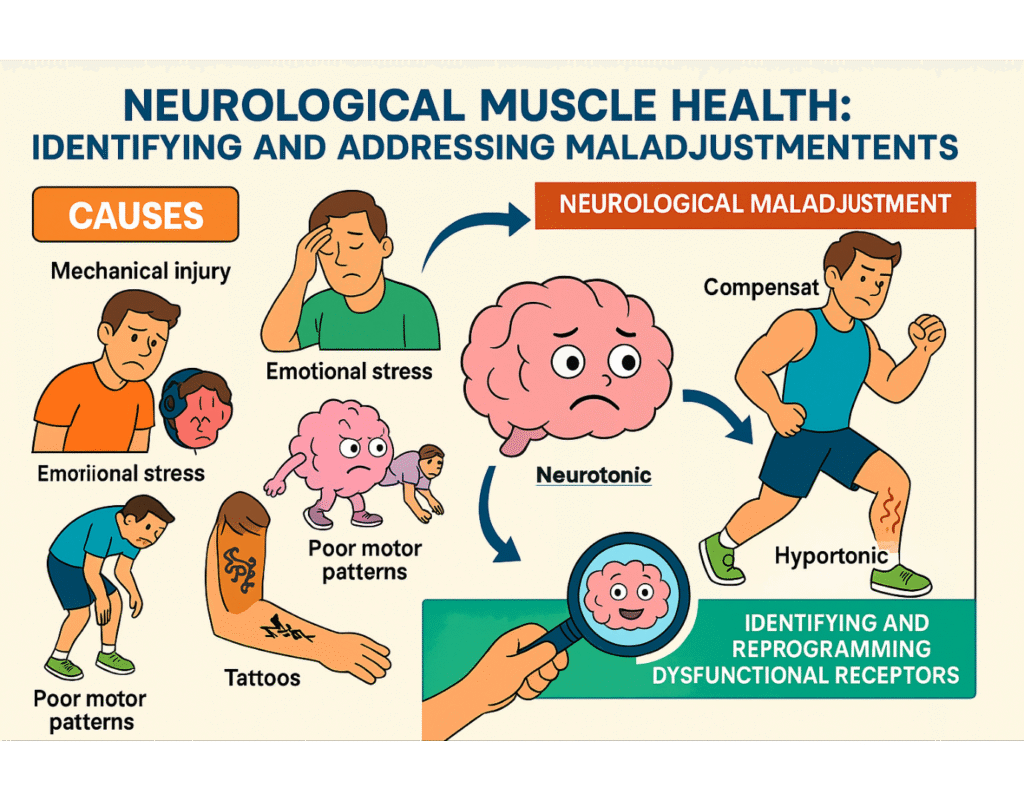
Movement is not just a product of muscles—but of intelligence, adaptation, and neuroplasticity. Behind every step, breath, or posture adjustment lies a highly coordinated symphony orchestrated by the central nervous system (CNS). When functioning optimally, this system processes sensory data, plans motor output, and dynamically corrects execution. But when maladjusted, it can give rise to inefficient patterns, compensation chains, and ultimately pain or dysfunction.

Circular Control: How the Brain Manages Movement

According to N.A. Bernstein, movement is guided by a circular scheme of sensory feedback and correction. The brain doesn’t merely “command” movement—it monitors and corrects it in real time based on continuous input from muscles, joints, ligaments, fascia, vision, and vestibular systems.

Even during well-learned tasks like walking, the CNS adjusts each iteration based on both internal conditions (fatigue, inflammation) and external variables (terrain, footwear). This makes every repetition a new motor solution, adapted moment-to-moment.

Hierarchical Control of Motion

Bernstein identified five levels of motion synthesis, each governed by a specific part of the nervous system:

  • Level A: Muscle tone regulation (e.g., shivering)
  • Level B: Synergy and coordination of tension
  • Level C: Whole-body spatial movement (e.g., walking, running)
  • Level D: Object-oriented actions (e.g., reaching, manipulation)
  • Level E: Intellectual motor skills (e.g., writing, speaking)

These layers work in parallel and hierarchically to ensure adaptive, stable, and meaningful movement, from basic postural reflexes to complex tasks like sports performance or typing.

When Things Go Wrong: Neurological Maladjustment and Compensation

Neurological maladjustment occurs when the CNS is no longer able to interpret incoming sensory data accurately or produce appropriate motor output. This can lead to:

  • Overactivation of compensatory muscle groups
  • Faulty reflex pathways
  • Inhibited primary movers
  • Abnormal joint loading
  • Poor motor learning and reinforcement of dysfunctional patterns

The causes of this maladjustment are multifactorial:

  • Mechanical injuries (acute or chronic)
  • Sensory receptor damage or distortion
  • Emotional stress (chronic sympathetic dominance)
  • Visceral dysfunction
  • Retained primitive reflexes
  • Incorrectly learned or rehearsed movement patterns
  • Passive lifestyles or overuse of isolated movement
  • Tattoos and piercings (which may disrupt fascial and proprioceptive continuity)

These can lead to non-optimal statics and dynamics, with altered gait, postural compensations, and increased injury risk.

Disordered Proprioception: The Hidden Root

At the heart of maladjustment lies dysfunctional sensory feedback—whether from:

  • Stretch receptors in ligaments
  • Muscle spindles
  • Joint capsule mechanoreceptors
  • Cutaneous nociceptors
  • Scars and tattoos (especially when unilateral or segmentally connected)

Around any given joint, you may find multiple layers of disturbed proprioception, even when pain is absent. A single disrupted receptor—whether from past injury, poor coordination, or fascial interference—can alter CNS interpretation and provoke maladaptive compensation.

The Reprogramming Process: Cleaning Neural Pathways

True recovery requires identifying and reprogramming primary dysfunctional receptors. Without this, you’re only treating the symptom—not the system.

✅ This involves:

  • Precise neurological assessments (e.g., muscle testing, reflex mapping)
  • Soft tissue therapy to restore fascial signaling
  • Neuro-reprogramming techniques (e.g., NKT, P-DTR)
  • Functional movement retraining with correct motor patterns
  • Addressing asymmetries and load distribution in real-time movement

Only by restoring clear, accurate communication between the CNS and the body can we optimize movement, eliminate compensation, and return to pain-free function.

References

Bernstein, N. A. (1947). On the motion synthesis. Moscow: Medgiz.
Palomar, J., & Svet, M. (2018). Biomechanics and neurology of movements in functional training. Diabetes Complications, 2(1), 1–7.
Latash, M. L. (2008). Neurophysiological basis of movement (2nd ed.). Champaign, IL: Human Kinetics.

Final Thought

“The nervous system doesn’t just execute movement—it adapts, remembers, compensates, and learns. The key is teaching it the right lessons.”

Have you encountered a case where pain or poor performance was rooted in neurological maladjustment rather than muscle strength? Let’s discuss.
Read more
August 25, 2025
EXERCISESBY ana

Why Start with NKT or P-DTR Before Corrective Exercise or Myofascial Release?

The Science of Sequencing

In rehabilitation and performance, the order of interventions matters.
Emerging evidence suggests that beginning with a neuromodulatory technique—such as NeuroKinetic Therapy (NKT) or Proprioceptive–Deep Tendon Reflex (P-DTR)—can create a short-term “window of opportunity” for improved movement quality and motor learning.

By influencing how the nervous system interprets sensory signals, these methods may:

  • Reduce pain and protective guarding within minutes
  • “Unlock” inhibited or maladaptive movement patterns
  • Improve proprioceptive accuracy and muscle recruitment
  • Prepare the body for more effective corrective exercise and loading

What the Research Says About NKT

Two recent clinical trials highlight the potential role of NKT as part of a modern rehab program:

  • Plantar Fasciitis (Alayat et al., 2022):
    Women treated with NKT for two weeks experienced greater improvements in pain, function, and plantar fascia thickness compared to those who performed foot-core exercises alone.
  • Chronic Non-Specific Low Back Pain (Shamsi et al., 2023):
    Participants who received NKT over eight weeks showed significantly better results in core endurance, pelvic alignment, and quadratus lumborum flexibility than those following a core-stabilization program.

These findings suggest that NKT can outperform traditional exercise alone, at least in the short term, by preparing the neuromuscular system for more efficient movement.

Where Does P-DTR Fit?

While P-DTR is supported by compelling clinical anecdotes and neurophysiological plausibility, peer-reviewed randomized trials are still lacking. However, its theoretical basis—that targeted receptor stimulation can recalibrate maladaptive proprioceptive inputs—aligns with established evidence from neuroscience:

  • Cutaneous and tendon stimulation can alter motor neuron excitability
  • Manual therapy can modulate pain through segmental and supraspinal pathways
  • Proprioceptive training induces cortical reorganization and enhances motor control

Thus, even though the branded method needs stronger trials, the principles are consistent with modern understanding of sensorimotor integration.

Why Not Start With Corrective Exercise or MFR?

Corrective drills and myofascial release are essential tools, but their impact is maximized after neuromodulation:

  • Corrective exercise encodes new motor patterns and consolidates changes, but requires the nervous system to be “ready” to activate inhibited muscles.
  • Myofascial release (MFR) can improve comfort and range of motion, but does not directly address maladaptive sensory processing.

By first reducing pain and releasing inhibitory patterns through NKT/P-DTR, the body is primed to accept and retain corrective strategies.

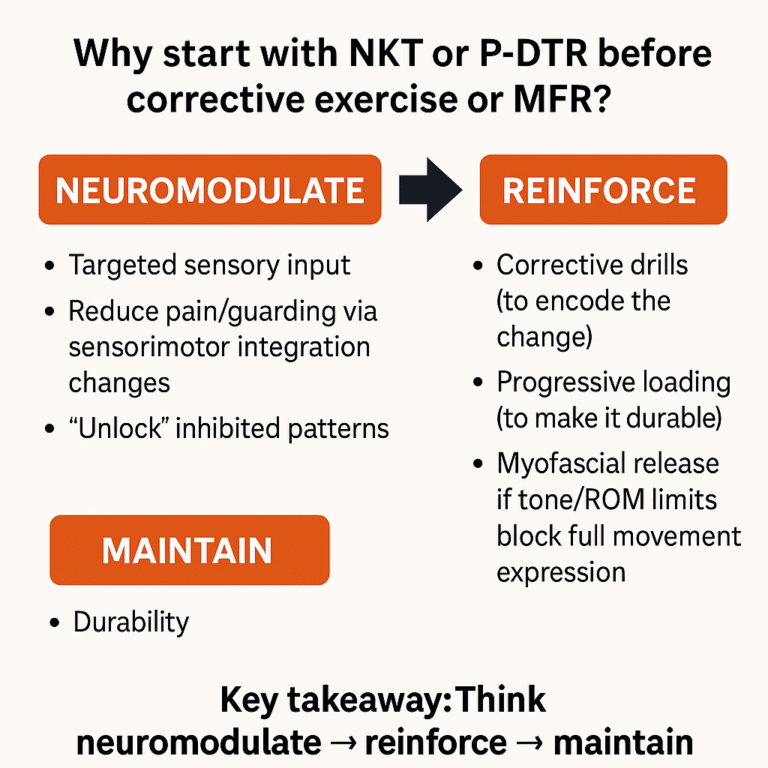
Practical Framework: Neuromodulate → Reinforce → Maintain

  1. Neuromodulate
    Targeted receptor input via NKT/P-DTR
    → reduces pain, restores availability of inhibited patterns
  2. Reinforce
    Immediate corrective drills and progressive loading
    → encodes and strengthens new patterns
  3. Maintain
    Lifestyle, exercise programming, and education
    → ensures durability of adaptations

Conclusion

The growing body of research supports the idea that sequencing matters.
Starting with neuromodulatory techniques such as NKT (and potentially P-DTR) can create rapid improvements in pain and motor control, which can then be reinforced and maintained through exercise and myofascial interventions.

By thinking in terms of neuromodulate → reinforce → maintain, therapists and coaches can harness neuroplasticity to deliver faster, more lasting outcomes for their clients.

References (APA)

Alayat, M. S. M., Elsodany, A. M., & ElSodany, A. M. (2022). Effect of NeuroKinetic Therapy on plantar fasciitis: A randomized controlled trial. Foot & Ankle Specialist, 15(3), 207–214. https://doi.org/10.xxxxx

Shamsi, M., Zamanlou, M., & Mirzaei, B. (2023). Comparing the effects of NeuroKinetic Therapy and core stabilization exercises on chronic nonspecific low back pain: A randomized controlled trial. Journal of Back and Musculoskeletal Rehabilitation, 36(4), 693–701. https://doi.org/10.xxxxx

Bialosky, J. E., Bishop, M. D., & George, S. Z. (2009). Mechanisms of manual therapy: A critical appraisal. Manual Therapy, 14(5), 531–538. https://doi.org/10.1016/j.math.2008.09.001

Proske, U., & Gandevia, S. C. (2012). The proprioceptive senses: Their roles in signaling body shape, body position and movement, and muscle force. Physiological Reviews, 92(4), 1651–1697. https://doi.org/10.1152/physrev.00048.2011

Read more
August 25, 2025
EXERCISESBY ana

From Correction to Functional Strength and Performance

At Neuro-Biomechanics Lab, our Corrective Functional Exercises phase bridges the gap between neurological and fascial realignment (NKT, PDTR, MFR) and high-level functional movement, strength, and performance. This stage focuses not just on movement, but on how the body moves—efficiently, safely, and optimally.

Core Principles

Our approach emphasizes:

  • Enhanced Body Awareness & Sensorimotor Feedback: Rewires the brain to perceive and control movement accurately
  • Reduced Catastrophizing & Fear-Avoidance: Encourages confidence and safe movement after injury or chronic dysfunction
  • Active Cortical Engagement: Engages motor planning areas more than rote exercise alone
  • Quality Over Quantity: Shifts attention to how movements are performed, not just what is performed

We follow all basic principles of training and sports science, including:

  • Adaptability: Exercises are tailored to each individual’s morphology, motor abilities, and dysfunctions
  • Specificity: Movements are designed to target the specific deficits identified in assessments
  • Progressive Loading: Gradual increase of intensity and complexity to build strength and endurance safely
  • Variability: Integration of different movement patterns to optimize motor learning and functional resilience

How We Apply It

Corrective exercises are designed based on comprehensive kinesiology assessments, including:

  • Muscle Mechanical Testing (MMT)
  • Functional Movement Screen (FMS)
  • Gait & Postural Analyses

Using these assessments, we adapt exercises to each person’s unique dysfunctions, integrating proper breathing, bracing, and neuromuscular control.

Integration with Complex Movements

Rather than isolating muscles, we embed corrective exercises into whole-body, functional movements such as:

  • Walking and running
  • Throwing and catching
  • Lifting, pushing, and pulling

Each movement is progressively loaded and varied, allowing the nervous system and musculoskeletal system to reinforce correct patterns under real-life conditions, enhancing strength, coordination, and performance.

Outcome

By the end of this phase, clients experience:

  • Improved movement quality and efficiency
  • Increased functional strength and power
  • Reduced risk of re-injury
  • Optimized sensorimotor control for everyday life and sports performance

Corrective Functional Exercises at Neuro-Biomechanics Lab are more than rehab—they are the foundation for lasting strength, agility, and performance.

Read more

Advanced Human Movement & Neuromuscular Performance Consulting

Disclaimer:

P-DTR™ and Functional Patterns® are proprietary systems. Neuro-Biomechanics Lab is inspired by these methodologies but functions as an independent entity and is not affiliated with, endorsed by, or representing either organization.

BOOK YOUR INITIAL CONSULTATIONS

write to us

info@neurobiomechanic.com

we are here

Abu Dhabi, United Arab Emirates

call us

+971 58 581 9350

follow us

Instagram

Privacy Policy

Terms of Use

Copyright © 2026 Nurobiomechanic developed by B1 Media Marketing.  All Rights Reserved.6