Beyond Exercise Labels: What Motor Control Research on Low Back Pain Still Misses
Low back pain (LBP) is one of the most common musculoskeletal problems worldwide, and exercise remains the most widely recommended intervention. Yet, decades of research still debate which form of exercise is “best”: motor control exercises (MCE), high-load strength training, yoga, Pilates, or general conditioning.
While large systematic reviews and randomized controlled trials (RCTs) provide valuable evidence, they also reveal an important limitation: the focus has been on “what exercise” is chosen, rather than “how it is taught, executed, and integrated.”
What the Evidence Says
- Motor Control Exercises (MCE)
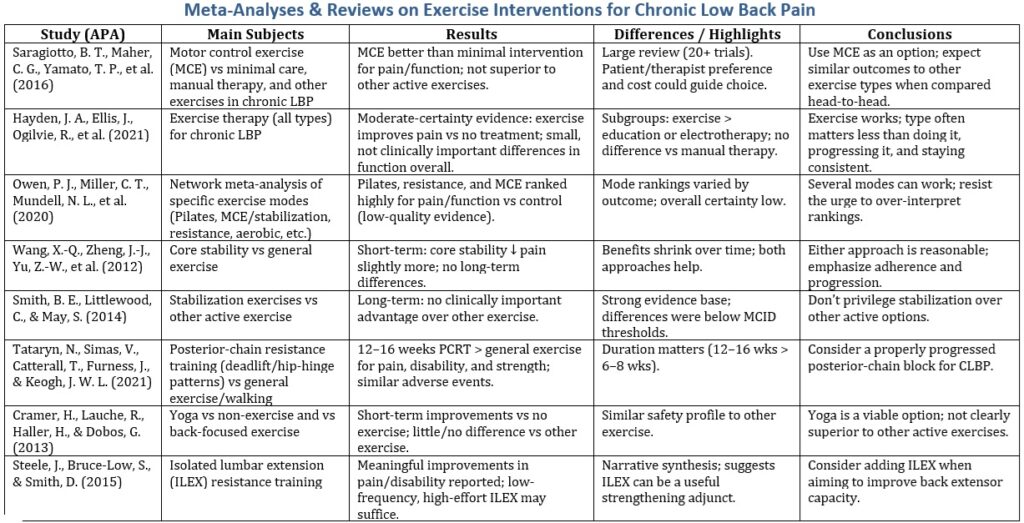
Cochrane reviews and large RCTs (e.g., Saragiotto et al., 2016; Aasa et al., 2015) show that MCE is more effective than minimal care and education, but not consistently superior to other forms of active exercise. - Strength Training & Posterior Chain Programs
Trials of deadlifts and posterior-chain resistance training show equal or greater improvements in pain and disability when conducted over 12–16 weeks (Tataryn et al., 2021). - Yoga, Pilates, and Hybrid Approaches
Yoga and Pilates demonstrate similar outcomes to MCE and resistance programs—suggesting the active ingredient lies not in the brand of exercise, but in the way movement is retrained. - Meta-analyses
Reviews consistently find that all active approaches outperform passive care, and that exercise type matters less than adherence, frequency, and program quality.
The Missing Links in Research
Despite these valuable insights, most clinical trials share common limitations:
- Attention and Awareness
Few studies measure the level of attentional focus during repetitions, even though awareness is central to motor learning and pain modulation. - Individualization Fidelity
While many trials describe “individualized” motor control programs, few provide standardized fidelity checks to ensure that exercises truly address each participant’s motor and postural dysfunctions. - Autonomic State & Fatigue
Trials rarely monitor heart rate variability (HRV) or sympathetic-parasympathetic balance, despite strong evidence that autonomic state affects pain sensitivity, coordination, and exercise tolerance.
Holistic Integration
Research designs often reduce interventions to protocols, leaving out the integration of neurology, fascia, biomechanics, psychology, and training methodology that underpins real-world clinical practice
Why Execution Matters More Than Labels
The practical reality is that the exercise label (MCE, deadlift, yoga, Pilates) is less important than how the exercise is taught and performed.
- Is it individualized to the person’s dysfunctions?
- Does it engage attention and awareness?
- Is it performed in an organized, neurophysiological muscle pattern?
- Is it adapted to the current level of fatigue and recovery state?
When these elements are optimized, the difference between MCE and strength training narrows considerably.
Implications for Practice
For clinicians, coaches, and fitness professionals, this means shifting the focus from “choosing the right exercise” to creating the right conditions for exercise to work.
- Educate clients on pain and body awareness.
- Individualize exercise selection based on motor control assessment.
- Integrate HRV and fatigue monitoring where possible.
- Foster attentional engagement and mindful execution.
- Blend methods — motor control, strength, mobility, and conditioning — as needed.
Conclusion
The evidence is clear: exercise works for low back pain. But the ongoing debate about which exercise is “best” distracts from the real issue. The missing link is not the exercise itself, but the way it is applied.
As movement professionals, we must push beyond exercise labels and unite neurology, anatomy, fascia science, biomechanics, psychology, and training methodology. Each training session should be explainable through multiple lenses — ultimately driving us closer to the goal of human movement optimization.
It’s not about prescribing exercises. It’s about creating conditions for movement to heal, adapt, and thrive.