

August 25, 2025
Chronic low back pain (CLBP) is one of the leading causes of disability worldwide. Exercise is widely recommended as a first-line treatment, yet debate continues about which exercise mode is most effective. Motor control exercises (MCE), strength-based programs, yoga, Pilates, and general conditioning all appear beneficial, but evidence comparing them remains mixed. This review synthesizes findings from major systematic reviews and meta-analyses to provide clarity for clinicians, researchers, and exercise professionals.
Evidence from Major Reviews
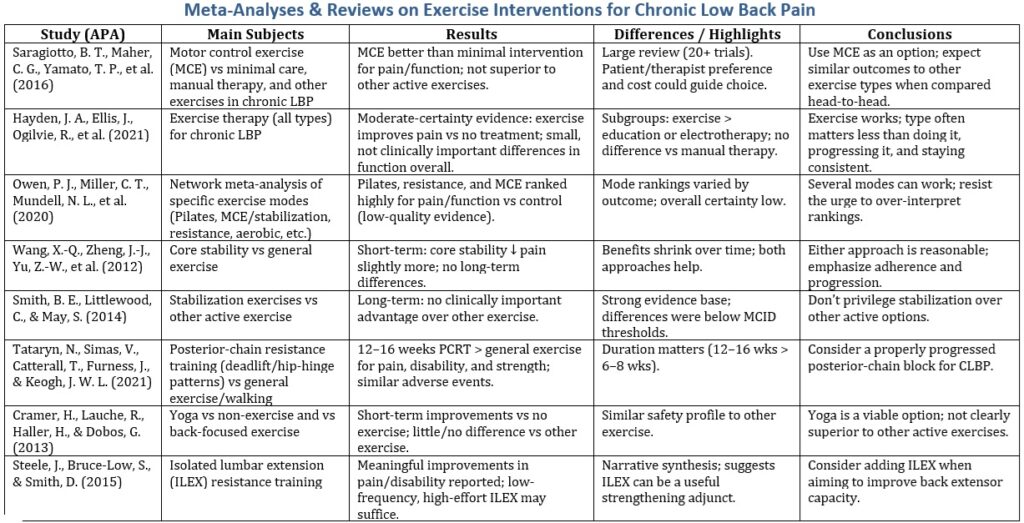
- Motor Control Exercises vs. Other Approaches
- Saragiotto et al. (2016, Cochrane Review)
MCE was superior to minimal care for pain and function but showed no clinically meaningful advantage over other active interventions such as general strengthening or manual therapy. - Smith et al. (2014, BMC Musculoskeletal Disorders)
Similarly concluded that stabilization and MCE provide no long-term superiority over other active exercises, suggesting that patient preference and therapist expertise should guide choice.
- General Exercise Therapy
- Hayden et al. (2021, Cochrane Review)
Across all exercise types, there is moderate-certainty evidence that exercise reduces pain and improves function compared to no treatment. Differences between exercise modes were small and often not clinically significant, reinforcing the message that adherence matters more than type.
- Specific Modalities (Yoga, Pilates, Resistance Training)
- Owen et al. (2020, Network Meta-Analysis)
Ranked Pilates, resistance training, and MCE highly for pain and disability reduction, though overall evidence certainty was low. - Cramer et al. (2013, Systematic Review)
Found yoga superior to no exercise but largely equivalent to other structured exercise programs in outcomes and safety. - Tataryn et al. (2021, Systematic Review & Meta-Analysis)
Reported that posterior-chain resistance training (e.g., deadlifts, hip-hinge movements) outperformed general exercise and walking when performed for 12–16 weeks, with gains in pain, disability, and strength.
- Core Stability & Lumbar Extension Training
- Wang et al. (2012, Meta-Analysis)
Core stability exercises yielded slightly greater short-term pain reduction than general exercise, but no long-term differences. - Steele et al. (2015, Narrative Review)
Found isolated lumbar extension (ILEX) training effective in improving pain and function, particularly as a low-frequency, high-effort adjunct to broader programs.
Limitations of the Evidence
Despite valuable findings, current research has notable gaps:
- Attentional focus during exercises is rarely measured, though awareness strongly influences motor learning.
- Individualization fidelity (how well exercises were tailored to each participant’s dysfunctions) is inconsistently reported.
- Autonomic state and fatigue (sympathetic/parasympathetic balance, HRV) are almost never monitored, despite their role in recovery and motor control.
- Heterogeneity across protocols and populations makes direct comparisons difficult.
These omissions may explain why trials often show similar outcomes across exercise modes.
Practical Implications
- Any active exercise is better than none — adherence, progression, and patient engagement drive outcomes.
- Motor control elements help retrain movement quality, while strength programs build resilience and load tolerance.
- Hybrid programs (e.g., MCE combined with resistance or lumbar extension) may optimize both coordination and strength.
Future research should incorporate measures of attentional focus, HRV, and individualization fidelity to capture the true effect of movement control.
Conclusion
Meta-analyses converge on one key message: exercise works for chronic low back pain, regardless of style. What remains underappreciated is that outcomes depend not simply on the exercise chosen, but how it is taught, individualized, and integrated into the patient’s broader neuromuscular and psychosocial context.
The next evolution in research and practice is not about declaring winners between motor control, yoga, or strength training—but about creating systems that optimize execution, awareness, and adaptation for each individual.
References
- Saragiotto, B. T., Maher, C. G., Yamato, T. P., et al. (2016). Motor control exercise for chronic non-specific low-back pain. Cochrane Database of Systematic Reviews, (1), CD012004.
- Hayden, J. A., Ellis, J., Ogilvie, R., et al. (2021). Exercise therapy for chronic low back pain. Cochrane Database of Systematic Reviews, (9), CD009790.
- Owen, P. J., Miller, C. T., Mundell, N. L., et al. (2020). Which specific modes of exercise training are most effective for treating low back pain? British Journal of Sports Medicine, 54(21), 1279–1287.
- Smith, B. E., Littlewood, C., & May, S. (2014). An update of stabilization exercises for low back pain. BMC Musculoskeletal Disorders, 15, 416.
- Cramer, H., Lauche, R., Haller, H., & Dobos, G. (2013). A systematic review and meta-analysis of yoga for low back pain. Clinical Journal of Pain, 29(5), 450–460.
- Tataryn, N., Simas, V., Catterall, T., Furness, J., & Keogh, J. W. L. (2021). Posterior-chain resistance training for chronic low back pain. Sports Medicine – Open, 7, 17.
- Wang, X.-Q., Zheng, J.-J., Yu, Z.-W., et al. (2012). Core stability exercise vs general exercise for chronic low back pain. PLoS ONE, 7(12), e52082.
- Steele, J., Bruce-Low, S., & Smith, D. (2015). Clinical value of isolated lumbar extension resistance training. PM&R, 7(2), 169–187.